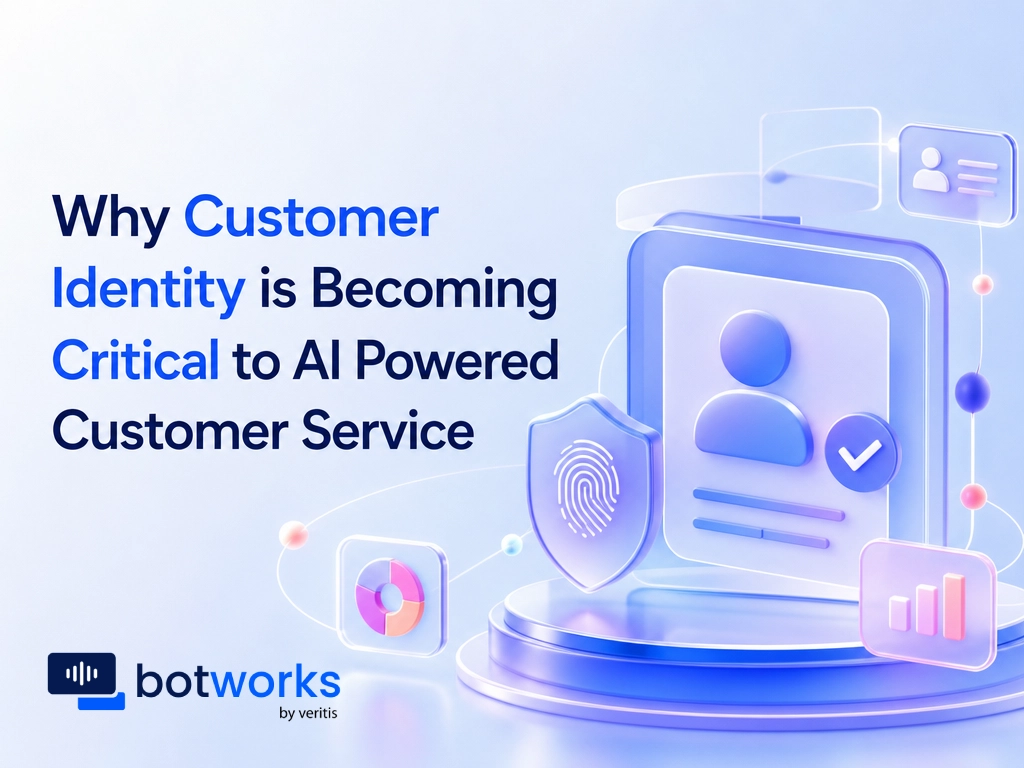
Customer identity is the foundation of AI powered customer service. It lets AI agents recognize each customer, protect their data, personalize every conversation, and take approved actions on their behalf. Without verified identity, AI cannot resolve issues safely or at scale.
This guide explains what customer identity means in an AI context, how it strengthens service delivery, the risks it manages, and the practices enterprise teams use to get it right.
What is Customer Identity in AI Context?
Customer identity is a verified, persistent, and unified view of a customer across every channel and system. Identity proofing, authentication, and profile management build it.
As of 2026, a strong customer identity does three things:
- Confirms who the customer is through verification.
- Persists across sessions and channels so the customer is never a stranger.
- Unifies scattered records into one accurate profile.
With that foundation in place, AI agents can securely access the right data, resolve identity across systems, personalize interactions, and act on the customer’s behalf with confidence.
This matters because AI customer service is no longer just about answering questions. Modern AI agents update records, process orders, and complete tasks. Every one of those actions depends on knowing exactly who is on the other end of the conversation.
Optimize Customer Service with AIWhy Customer Identity is a Core AI Customer Service Capability
Enterprises are moving quickly toward AI powered customer service that resolves issues rather than simply routing them. According to Gartner, by 2026, 1 in 10 agent interactions is expected to be automated end to end. That scale of automation is only possible when the AI knows precisely who it is serving.
Consider a customer who calls to update a payment method and then follows up on chat about a delayed order. Without unified identity, those two interactions are disconnected. The customer repeats themselves. The AI cannot act. The agent steps in unnecessarily. Identity is what closes that gap.
Key takeaway: Customer identity is not an IT configuration. It is an enterprise capability that directly determines how much value AI powered customer service can deliver.
How Does Customer Identity Enhance AI Service?
1) Identity Components for Seamless AI Service
Three building blocks make identity aware AI possible:
- Verification and durable profiles. These confirm customers are who they claim to be and link that proof to a lasting profile.
- CIAM technologies. Customer Identity and Access Management enables sign up, login, secure access, and consent management with minimal friction.
- Identity resolution systems. These unify fragmented records across CRM, billing, and support tools to keep each profile accurate.
Together, these components let an AI agent pick up a conversation with full context instead of asking the customer to repeat themselves.
2) Secure Customer Identity Verification
Strong authentication and authorization controls keep AI interactions safe:
- Multi Factor Authentication (MFA). MFA improves security by requiring users to verify their identity through multiple authentication methods before access is granted.
- Just in Time Authorization. AI systems request temporary permissions only for the specific task at hand, then release them immediately.
Key takeaway: Verification is not a one time gate. It is a continuous discipline that scales with the sensitivity of each action.
What are the Risks and Security Measures in Customer Identity?
Poor identity management opens the door to real threats. The most common risks are impersonation, unauthorized access, and incorrect customer matching. Each can damage trust and expose sensitive data.
Enterprises reduce these risks with layered controls:
- Fraud prevention. Robust identity verification lowers the chance that a bad actor is served as a genuine customer, protecting both the business and its clients.
- Fine grained identity controls. AI agents should operate under scoped permissions and token vaulting so every action is safe, authorized, and auditable.
- Anomaly detection. Continuous monitoring flags unusual patterns in real time, enabling fast response before damage occurs.
The goal is clear. The AI should only ever do what it has been explicitly permitted to do, for the person it has confirmed it is serving.
How Does Identity Aware Interaction Benefit Customer Service?
1) Seamless Omnichannel Support
When identity travels with the customer across chat and voice, the experience stays consistent and frictionless.
- Unified interaction history. AI systems can read past conversations and provide relevant, contextual help in real time.
- Personalization and engagement. With identity data, AI tailors each interaction to past behavior, preferences, and account status.
A customer who starts on chat and finishes on voice should never lose context. Identity is what carries that context across the gap.
2) AI Powered Customer Service That Levels Up Personalization
Personalization is where identity aware AI delivers the clearest business results. When the AI knows a customer’s history, preferred channel, language, and product usage, it can anticipate needs rather than react to them.
Practical examples include:
- Greeting a returning customer by name and surfacing their open ticket without prompting.
- Recommending a relevant self service option based on prior behavior.
- Adjusting communication style based on documented preferences.
According to Salesforce, 73 percent of customers expect organizations to understand their unique requirements and expectations. Identity aware AI is the mechanism that makes this expectation achievable at enterprise scale. You can see this in action through AI customer service case studies from enterprise deployments.
3) AI Powered Customer Service That Levels Up Storytelling
Beyond personalization, identity enables AI to tell a coherent story across every interaction. The customer does not experience a series of disconnected transactions. They experience a relationship.
This matters for brand trust. When an AI agent recalls a prior complaint, references a recently completed order, or acknowledges a long term customer relationship, it communicates competence and care. That narrative continuity is only possible when identity data is unified, current, and accessible to the AI in real time.
4) Enterprise System Integration
Identity delivers its full value only when it connects to core business systems.
- CRM integration. Aligning AI with CRM data deepens the personalization and context of every interaction, giving agents a complete picture of the customer relationship.
- Workflow integration. AI agents can trigger enterprise workflows to complete tasks including order processing, appointment scheduling, or account updates without manual handoffs.
This is where AI service moves from conversation to resolution.
What Are the Risks and Security Measures in Customer Identity?
Poor identity management opens the door to real threats. The most common risks are impersonation, unauthorized access, and incorrect customer matching. Each can damage trust and expose sensitive data.
Enterprises reduce these risks with layered controls:
- Fraud prevention. Robust identity verification lowers the chance that a bad actor is served as a genuine customer, protecting both the business and its clients.
- Fine grained identity controls. AI agents should operate under scoped permissions and token vaulting so every action is safe, authorized, and auditable.
- Anomaly detection. Continuous monitoring flags unusual patterns in real time, enabling fast response before damage occurs.
The goal is clear. The AI should only ever do what it has been explicitly permitted to do, for the person it has confirmed it is serving.
How Does Identity Aware Interaction Benefit Customer Service?
1) Seamless Omnichannel Support
When identity travels with the customer across chat and voice, the experience stays consistent and frictionless.
- Unified interaction history. AI systems can read past conversations and provide relevant, contextual help in real time.
- Personalization and engagement. With identity data, AI tailors each interaction to past behavior, preferences, and account status.
A customer who starts on chat and finishes on voice should never lose context. Identity is what carries that context across the gap.
2) AI Powered Customer Service That Levels Up Personalization
Personalization is where identity aware AI delivers the clearest business results. When the AI knows a customer’s history, preferred channel, language, and product usage, it can anticipate needs rather than react to them.
Practical examples include:
- Greeting a returning customer by name and surfacing their open ticket without prompting.
- Recommending a relevant self service option based on prior behavior.
- Adjusting communication style based on documented preferences.
According to Salesforce, 73 percent of customers expect organizations to understand their unique requirements and expectations. Identity aware AI is the mechanism that makes this expectation achievable at enterprise scale. You can see this in action through AI customer service case studies from enterprise deployments.
3) AI Powered Customer Service That Levels Up Storytelling
Beyond personalization, identity enables AI to tell a coherent story across every interaction. The customer does not experience a series of disconnected transactions. They experience a relationship.
This matters for brand trust. When an AI agent recalls a prior complaint, references a recently completed order, or acknowledges a long term customer relationship, it communicates competence and care. That narrative continuity is only possible when identity data is unified, current, and accessible to the AI in real time.
4) Enterprise System Integration
Identity delivers its full value only when it connects to core business systems.
- CRM integration. Aligning AI with CRM data deepens the personalization and context of every interaction, giving agents a complete picture of the customer relationship.
- Workflow integration. AI agents can trigger enterprise workflows to complete tasks including order processing, appointment scheduling, or account updates without manual handoffs.
This is where AI service moves from conversation to resolution.
How Do Privacy and Security Govern Customer Identity Management?
1) Compliance and Trust
Enterprises must manage customer data within clear privacy and security standards. Regulatory requirements are increasing in scope and enforcement, and customer expectations for responsible data management are increasing alongside these changes.
- Regulatory compliance. Apply proven frameworks such as NIST and OWASP to meet data protection requirements across jurisdictions.
- Governance and oversight. Maintain strict audit controls and governance to manage consent, document data use, and protect customer data at every touchpoint.
Trust is earned through control. Customers share more, and AI serves better, when data handling is transparent and accountable.
2) Escalation for Sensitive Interactions
Even the most capable AI needs human judgment at the right moments. Intelligent escalation is a feature, not a failure.
- Intelligent escalation. AI should hand off to a human agent when complexity exceeds its defined scope, when the interaction is highly sensitive, or when the customer asks for a person.
- Trust preservation. Customers expect access to a person when it matters, and that access sustains long term confidence in the AI.
Key takeaway: The best AI service knows its limits and escalates cleanly, without forcing the customer to start over.
What Are the Best Practices for Identity Aware AI Customer Service?
1) Building Identity Centric AI Service
- Customer consent management. Keep data use transparent, clearly communicated, and actively consented at each stage.
- Regular security audits. Review identity systems on a defined schedule to identify gaps and preserve integrity over time.
- Continuous identity monitoring. Watch for unauthorized access attempts and respond quickly to contain exposure.
- Role based access controls. Limit what each AI agent can see and do based on the task, channel, and customer relationship.
2) Introducing Multi Product Identity Solutions
Large enterprises often manage identity across multiple products, divisions, and geographies. A single unified identity layer that spans these environments allows:
- Consistent customer recognition regardless of which product or channel the customer contacts.
- Centralized governance and audit logging across all touchpoints.
- Faster deployment of new AI service capabilities because identity infrastructure is already in place.
For organizations evaluating AI readiness, the 7 key considerations for AI agents in customer service are a practical starting point for assessing identity maturity alongside other readiness factors.
3) The Business Value of Combining Customer Identity with AI
Pairing identity with AI improves security and personalization, and it drives measurable business results:
- Efficiency and cost reduction. Automated workflows cut the manual workload on service teams, reducing cost per interaction.
- Improved customer satisfaction. Tailored engagement leads to better experiences, faster resolution, and stronger loyalty.
- Scalable service delivery. Enterprises can grow service volume without sacrificing quality, security, or compliance.
Understand the customer. Take the right action. Resolve the issue. Measure the outcome. That cycle only works when identity is solid.
Conclusion
Customer identity is the critical foundation for secure, personalized, and actionable AI powered customer service. When enterprises pair robust identity management with capable AI, they raise efficiency, lift satisfaction, and protect trust across every interaction. Organizations ready to move further can book a consultation with BotWorks to explore AI solutions built for real resolution and measurable performance.
Talk to an AI Customer Service ExpertFAQs: AI Powered Customer Service
What is customer identity in AI powered service?
Customer identity in AI powered service is the verified, unified view of a customer across platforms and channels. It enables secure, personalized, and context aware AI interactions at enterprise scale.
How does customer identity enhance AI service?
It combines verification, durable profiles, and CIAM technologies. Together, these boost both security and personalization while keeping friction low for the customer.
What are common risks in customer identity management?
The main risks are fraud, unauthorized access, and incorrect customer matching. Robust verification, fine grained identity controls, and continuous monitoring address each one.
Why does AI need customer identity to take action?
AI agents update systems and complete tasks on a customer’s behalf. Verified identity ensures every approved action is scoped to the right person and logged for governance purposes.
When should AI escalate to a human agent?
AI should escalate when a request exceeds its defined scope, involves high sensitivity, or the customer asks for a person. Clean handoffs that preserve context sustain customer trust.
What is CIAM and why does it matter for AI customer service?
CIAM stands for Customer Identity and Access Management. It governs how customers sign up, authenticate, and grant consent. In AI powered service, CIAM is the infrastructure layer that makes secure, personalized automation possible.